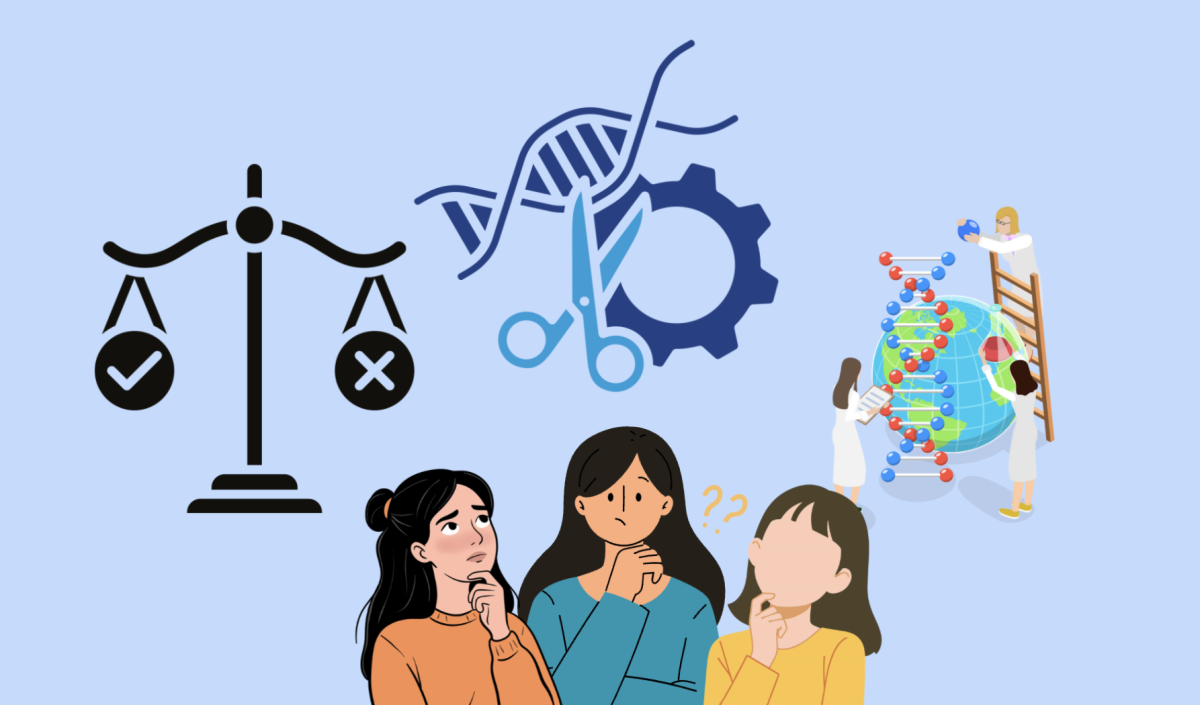
It’s official: Jennifer Doudna and Emmanuelle Charpentier’s CRISPR-Cas9, one of the world’s most powerful tools for genetic engineering, is becoming more commercial. This powerful tool is remodeling scientific potential for curing conditions once thought untreatable, such as sickle cell, cystic fibrosis, muscular dystrophy and more.
At NDB, many students aspire to be great biological scientists and medical professionals. We are given the opportunity to learn in an environment that is always adapting to the world’s innovations. As growing and maturing women, I believe it is important that we express our own ideas of radical changes in our society.
So, let’s ask this question: What does NDB think of genetic engineering? More importantly, how do our personal ethics and religious affiliations influence our answers?
Sophomores Clara Preuss and Grace Richmond introduced a fresh take on the subject by sharing their “conflicting feelings about it, because I [Preuss] don’t know exactly how it would affect the organism if you change the genetics. As long as it doesn’t affect any organism in a harmful way, it’s okay. More research needs to be done to have an overall understanding.” Richmond contrasted by saying that, historically, gene modification was the driver of discriminatory eugenics.
To get a sense of how student leaders at NDB try to incorporate this new technology into their clubs and passions, I asked Biology Club President Sophie Hu to share her stance on gene modification. She contributed by explaining, “Ever since the Cas-9 gene engineering system was discovered, it’s completely transformed biomedical research. They’ve already used it for treating a baby from a disease. As for morals, I do think there is an extent to which we should conserve the power of gene editing. We shouldn’t abuse it. As president of the biology club, I do hope to do one event related to gene editing – probably extracting DNA – and then talking about what gene editing can do to our bodies.”
This topic has been rigorously studied in Mrs. Girard’s AP Bio Class. “Genetically modifying animals can make animals resistant to viruses, increase food production, reduce pollution, and help with climate adaptations,” said senior AP Biology student Emma Kistler. “However, genetically modifying animals can also cause serious problems for the animal, such as death, infertility, health issues, or stunted growth. Because of these risks, many people question whether changing animals for human benefits is truly ethical, even though there is no right or wrong answer.”
Senior Khushi Patel stated, “Gene therapy offers life-changing possibilities for people with genetic disorders, but society must carefully consider ethical boundaries. Scientific advancement gives humans the ability to edit genes, yet ethical responsibility must guide how doctors and researchers use that ability.”
But where does the Catholic Church stand on this genetic advancement? The United States Conference of Catholic Bishops’ 2023 Doctrinal Note on Genetic Manipulation clearly states that the Catholic Church believes “everything possesses its own stability, truth and goodness, and its own laws and order, which should be respected by us in recognizing the methods which are appropriate to the various sciences and arts.” Catholics do not view the world as an entity that can be subjugated to wanton manipulation. However, the Catholic Church does support bodily, non-inheritable gene therapy that can cure people of their ailment.
I consider myself a practicing Catholic. My personal morals question the ethicality of parents choosing a genotype for their child, but those values become conflicted when inserting a heritable gene to suppress a disorder. I feel that it is completely fine to treat people in life, but doubts arise in the prenatal sense.
At the end of the day, this question’s answer becomes different due to many opposing perspectives and circumstances. We all even have diverse interests that may not necessarily lean towards this topic. Whether or not you have a passion for science and the ethics behind this technology, we as a community should all take the time to learn more about the exciting advances — and the ethics guiding them — that continue to become part of everyday life.