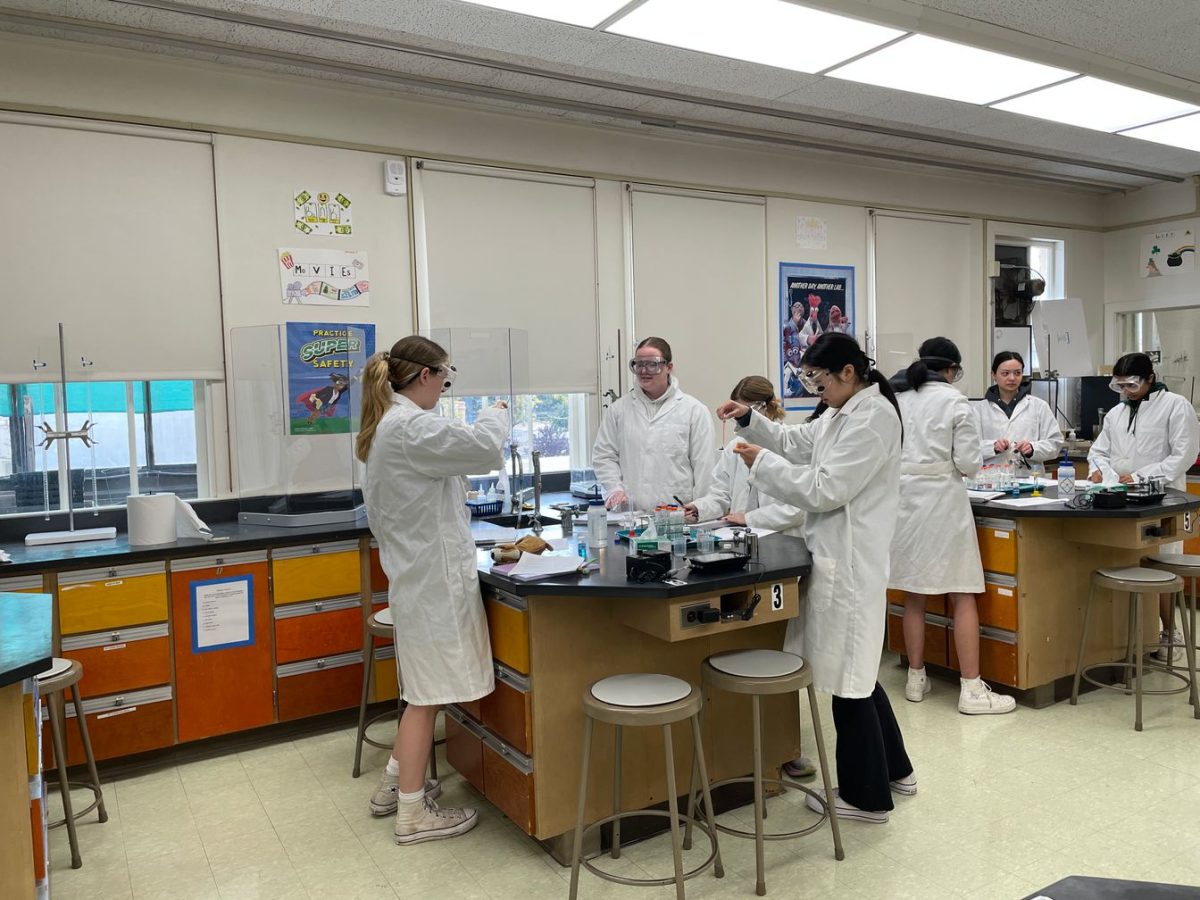
From physics classrooms to technology companies, many of the fields driving innovation today remain overwhelmingly male. Despite decades of progress, women continue to be underrepresented across STEM (science, technology, engineering and mathematics) fields around the world. As more young women begin pursuing these careers, conversations about representation and opportunity are becoming increasingly central to the future of STEM.
For students planning to enter these fields, pursuing STEM can also mean stepping into spaces where women have historically been less visible. Due to that imbalance, many young women find themselves not only choosing a career path but also challenging long-standing gender norms that have shaped these industries for generations.
“In such a male-dominated field, I feel like you have a really, almost like a boys club that’s just really toxic, and … impedes the sharing of ideas,” said senior Saree Formanek, who plans to study mechanical engineering at Johns Hopkins University. “And, I think the more women we can get into engineering, the more creative we can be, the more innovative we can be.”
For some, interest in male-dominated fields does not always begin with certainty. Instead, confidence can grow through research, exposure and seeing other women already succeeding in those spaces. Seeing representation in these industries can make the possibility of pursuing similar paths feel more realistic and attainable.
“At first, I kind of felt … scared and … kind of unsure if I really wanted to do that, but I feel like the more I didresearch, and … the more I kind of looked at other women who were also in the field, I kind of felt more comfortable,” said senior Alyse McBride who plans to study mechanical engineering at Boston University.
While individual experiences and confidence play a role in encouraging women to enter these fields, the gender imbalance seen in scientific fields today is also rooted in a much longer history of exclusion from education and professional opportunities.
“Historically, men in power, specifically, made rules so that women could not access education of any kind … They would spread rumors that were false, that women don’t have the sensibilities for formal education, let alone science education … So, it was very intentional to subdue women,” said Physics teacher Tiffany Poutivski. “We can find this all over and throughout history, around the world. So, you fast-forward hundreds of years later – That’s why they’re male-dominated, because they were meant to be male-only spaces.”
Because of that history, supportive academic environments can play an important role in helping young women feel comfortable participating in subjects where they may otherwise feel discouraged. Encouragement from peers and teachers can make it easier for students to share ideas, take risks and build confidence.
Math Department Chair Jennifer Walton said, “… I’ve taught at … public schools before, and I feel like … here we’re really empowered. I think you guys empower each other … and you’re so helpful to one another … Because I would see that in public schools … the guys would be kind of discouraging to the girls, and then it’s hard … when you’re trying to come up with answers … put yourself out there … especially if people are making fun of you or something. So, I like our community here.”
As more women pursue fields traditionally dominated by men, their presence is gradually reshaping spaces that were once designed to exclude them. Through confidence, representation and supportive environments, the next generation of women in STEM continues to challenge long-standing barriers while expanding the perspectives shaping innovation and redefining who belongs in these fields.