Why do we want to build Artificial Intelligence in the image of humans, but at the same time, fear that it will replace us?
This is a long discussion that dates back to the thirteenth century, as the theological concept in medieval Christianity suggested. Known as the “Great Chain of Being,” it ordained a hierarchical structure from God, Angels, Humans, Animals, Plants, to Objects. Robots, or any artificial intelligence, technically all fall in the “objects” category. It is not surprising that when it overcomes the ranking and acquires traits only humans have, such as thinking, writing or even creating, we will have an aversion towards it.
The long debate about artificial intelligence, or the obsession with creating life, can also be dated back to the thirteenth century. In the apocryphal tale of Descartes’s daughter, the philosopher attempts to replace his deceased child with an automaton. The intense fear of loss, or aversion towards loneliness, has been a long motivation for us to create something that is like us, that can unconditionally accompany us. It is thus unsurprising that we make modern AIs – ChatGPT, Gemini and Deepseek all stimulate and communicate like an actual human being.
The invention of the Large Language Model (LLM) and research in machine learning are not sudden creations of the 21st century; starting from the post-war research on frogs’ and cats’ vision, replicating biological neural systems builds the foundation of modern machine learning. As Jerome Lettvin’s seminal paper “What the Frog’s Eye Tells the Frog’s Brain” suggests, the frog’s vision does not reconstruct a complete picture of reality, but rather relies on evolutionary “shortcuts.” It detects moving contrast to catch a fly without understanding the concept of a “fly.” Instead of “copying and pasting” the neural structure of a human, the foundation of machine learning relies on the biological “shortcuts” that reduce calculation.
Widely considered the first chatbot and landmark early AI program is a model called ELIZA, developed by Joseph Weizenbaum, an associate Professor at MIT between 1964 and 1967. ELIZA was a therapist, but the truth is that she would only reframe your statement into new questions and ask them back. For instance, if you say, “I am sad today,” she would answer, “Why are you feeling sad then?”
Seeming more like a hoax than an intelligence therapist, Wezenbaum was expecting that the participants would lose interest immediately. According to an article from the Weizenbaum Institute, to Weizenbaum’s dismay, many participants engaged in serious conversations with ELIZA, confiding intimate and emotional details to the machine. Some participants not only developed a close relationship with ELIZA but also attributed empathy to the program. Even some practicing psychotherapists believed that the program could automate talk therapy.
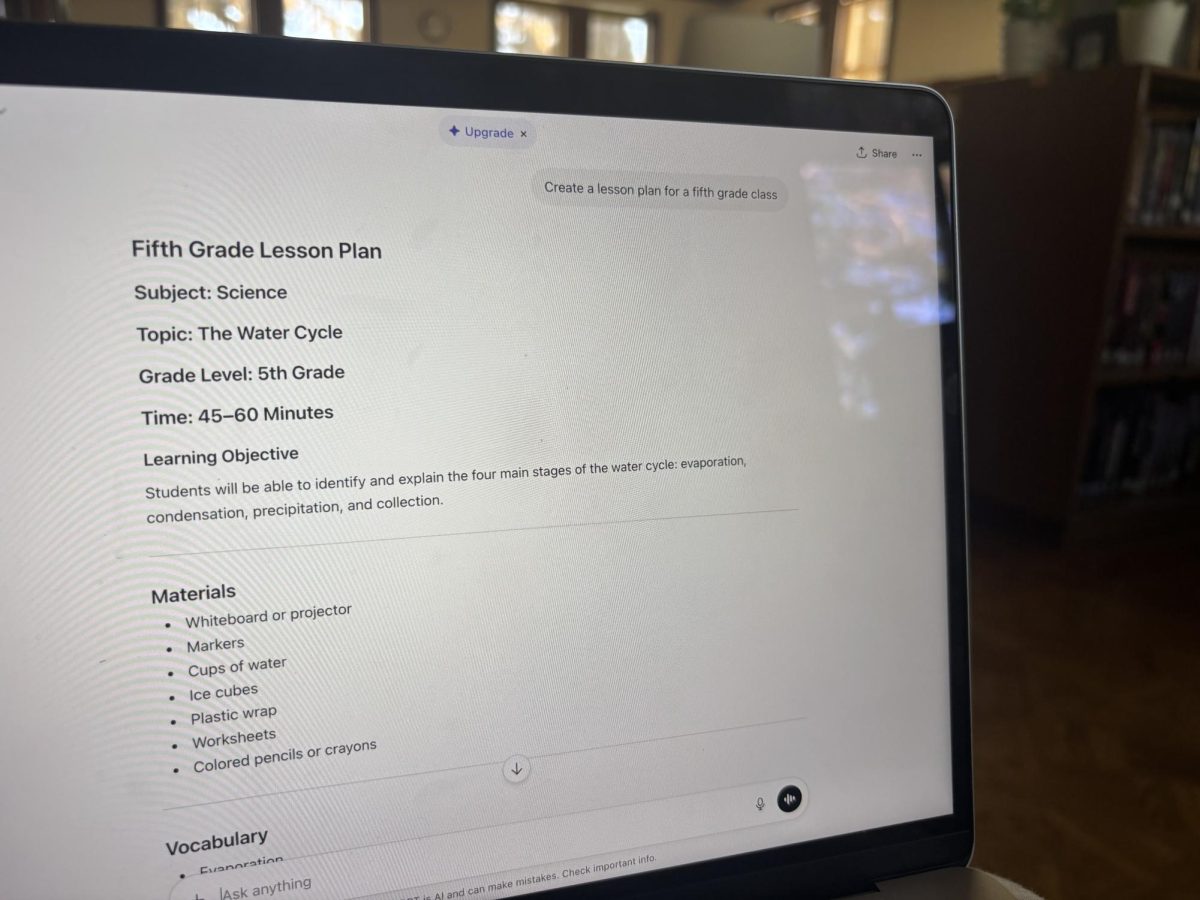
This overlaps with our experience with ChatGPT and other LLMs. We talk to them like real people, ask for their advice and develop empathy towards them, as if they are our “friends.” Although consciousness tells us they are merely tools with no soul or thoughts, the human brain is so eager for social connection that it will grant a “soul” to anything that simply follows the rules of polite conversation. Researcher Cliffor Nass argued that it is the social cues that evoke users’ social perceptions and social attitudes. These social cues include but are not limited to language, voice, human faces, emotions, interactivity, engagement, autonomy and unpredictability. It is almost a social obligation that we treat AI like human beings, using words such as “please,” “thank you,” and “can you…”
The real question our generation is facing is that, as AIs become more developed, they are taking over jobs. This is the main worry and anxiety about the progression of technology. Technology will inevitably replace old jobs in every industrial revolution. But this time is different, they said. If the industrial revolution in the eighteen-century subverted productivity and manual labor, the AIs nowadays are replacing our brain, the most complicated and special thing about us being humans – intelligence. If intelligence could be easily replaced, the belief we were once proud of would collapse in an instant.
As a writer, I was once daunted by how ChatGPT can produce fiction, poetry and everything you demand in an instant. Sophisticated vocabulary and high productivity, it has every reason to replace me, a non native writer who lacks vocabulary, a procrastinator who couldn’t write for months due to lack of ideas. When the things you spent so much effort on could be achieved in an instant, what is the point of even putting effort in? Coincidentally, writing poetry is not only specialized by ChatGPT. In the nineteenth century, grocer and printing shop worker John Clark invented a machine that could generate poetry, Euroka. It could produce 26 million unique lines of poetry. To an observer in the 19th century, it felt like the machine was “thinking” or possessed by a “ghost,” but it was actually just a physical calculator for language. This urges us to think about the purpose of literature itself. Perhaps it is the impulse to write, the tears converging in the eyes after reading a book, or the different interpretations of short poems. Perhaps it is to see all that is good, and all that is bad, all that is told in folklore and stories, all that connects us and separates us, all that means to be a human being, to experience, to feel, and to express. Perhaps that is why we still wait until the next Hunger Games sequel to come out, we still go to museums just to see the Mona Lisa in person and we still embrace nature and put it down on our canvas or in our cameras.
Philosopher Martin Heidegger argued that our life has meaning precisely because it ends. Every choice we make is “heavy” because we only have a limited amount of time. The war in Silicon Valley is drastic – money, technology, AI – a rat race that seems to neglect all the struggle and all the pain we went through.
If you slow down, you will find that life is, long or short, unique to ourselves, all about the scenery we see on our way. It is okay to live slowly, in our dreams and imperfectly.