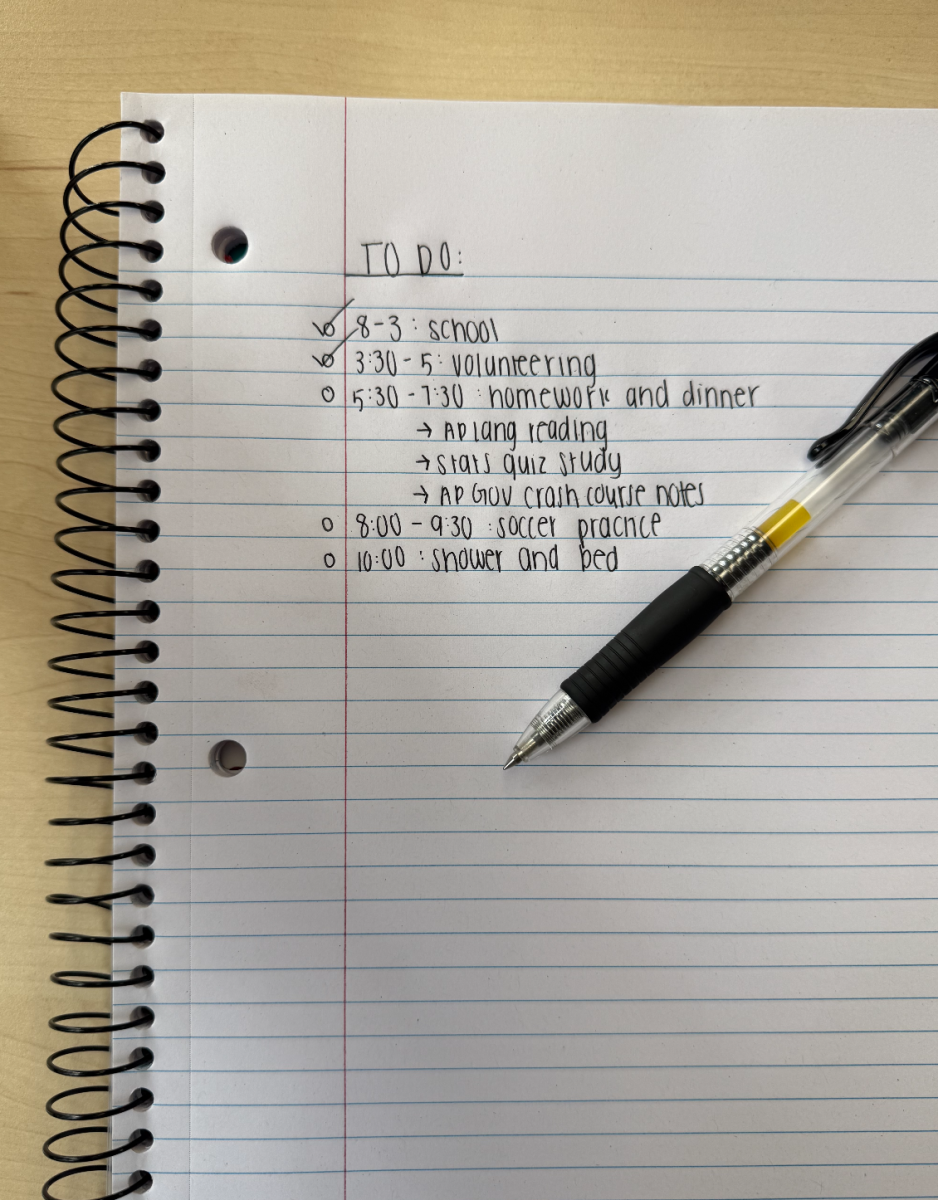
In school hallways, group chats and social media feeds, one question seems to echo louder than ever: How busy are you? For today’s teenagers, a packed schedule is no longer just a consequence of ambition; it has become a status symbol. From advanced classes to sports, clubs, jobs and volunteer hours, constant busyness is often seen as proof of motivation, success and worth.
At many high schools, students casually trade stories about staying up past midnight to finish homework or rushing from practice straight to work. These conversations are rarely framed as complaints. Instead, they are worn like badges of honor. The more exhausted someone is, the more productive they are assumed to be.
Social media has amplified this mindset. Platforms filled with study vlogs, practice clips and aesthetic planners present busyness as something to be admired. Students don’t just live their packed schedules; they document them.
Senior Avery Jones explains, “having a packed day and things to do throughout my day that I get to document and share keeps my busy and not worried about outside opinions and thoughts.” For Avery, staying busy is not only about productivity but also about distraction. A full schedule leaves little room for self-doubt or judgment.
This connection between busyness and self-worth is becoming increasingly common. Many students feel pressure to prove that they are doing enough, even when they are already stretched thin.
Sophomore Lilly Roach says, “I sometimes worry about what people think, if I’m lazy, or if I work hard enough, so I try to pack my days.” Her words reflect a fear shared by many teenagers: that slowing down might be interpreted as failure.

The idea that “busy equals successful” is deeply rooted in competitive academic culture. College applications often emphasize involvement, leadership and achievement, encouraging students to take on as much as possible. Over time, this can turn into a cycle where students feel obligated to add one more activity, even if they are overwhelmed.
However, there is a quieter side to this trend. While packed schedules may look impressive, they can hide burnout, anxiety and exhaustion. Students often sacrifice sleep, mental health and personal time in order to keep up appearances. The constant need to be productive leaves little space for reflection or rest, both of which are essential for growth.
Some students are beginning to question whether constant busyness is truly healthy. A growing number are advocating for balance, recognizing that productivity should not come at the expense of well-being. They argue that being valuable as a person should not depend on how many tasks you can cram into a single day.
Still, the pressure remains strong. In a culture that praises hustle and multitasking, choosing to slow down can feel rebellious. Yet, redefining success may be the key to breaking this cycle. Instead of asking, “How busy are you?” perhaps students should ask, “Are you doing what makes you happy?” or “Are you taking care of yourself?”
As extracurriculars and busy schedules continue to function as status symbols, students face an important choice: chase constant activity or seek meaningful balance. The challenge moving forward will be learning that worth is not measured by exhaustion, and that sometimes, doing less can actually mean living more.