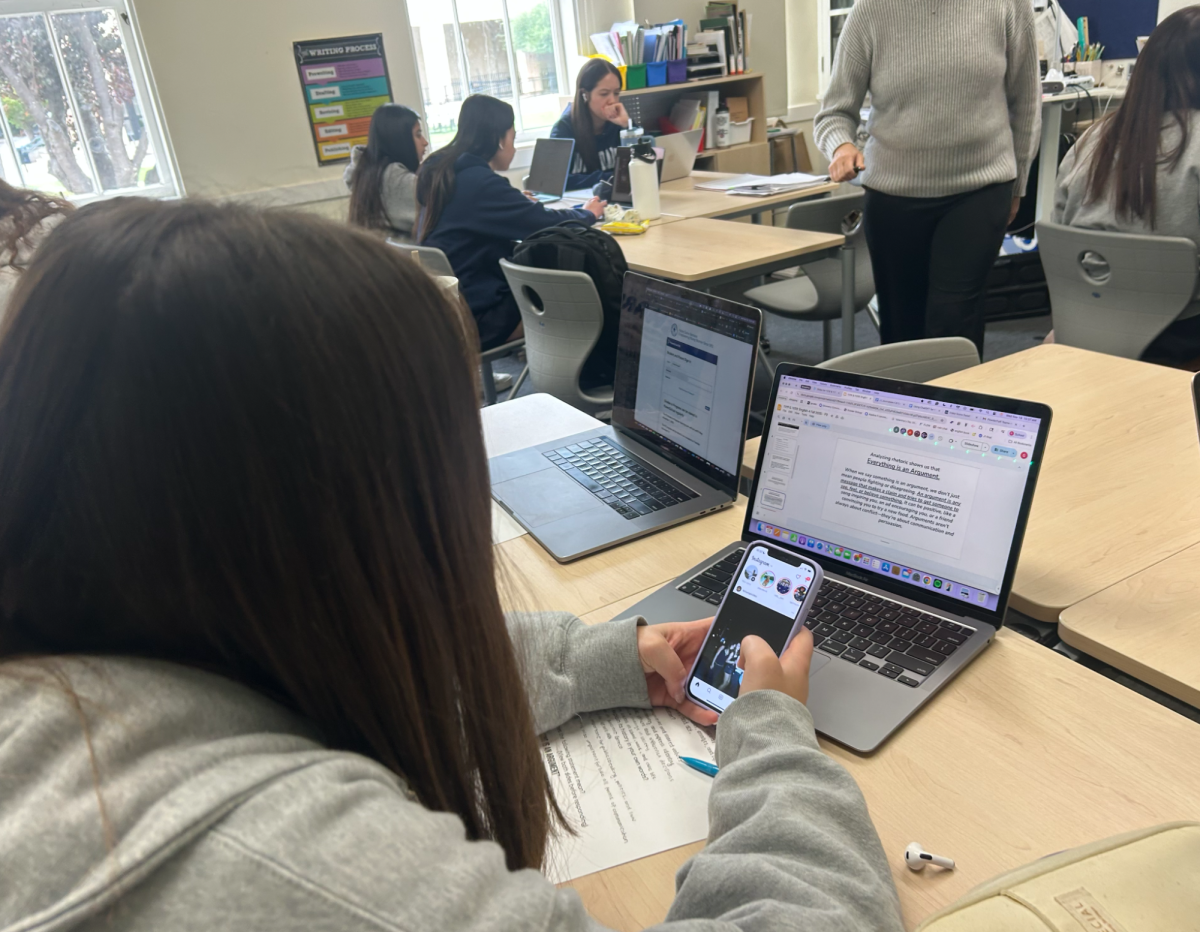
With all the social media apps that teenagers download, it’s given that some teens will have increased screentime. When teenagers have their phones in their hands, it’s more likely that they will be tempted to start texting their friends, scrolling through social media, or partaking in any of the other countless possibilities that a phone offers.
“Thanks to the psychologists that have created addictive apps, all age groups are craving that dopamine ‘hit’ that keeps their phones in their hands most of the day,” explained Amy Artal, mother of two teenagers who have high phone usage.
Especially with the new phone policy at NDB, teenagers find themselves having symptoms of withdrawal, and they find themselves having cravings and missing their phones. Some students even go so far as to try and get past the phone policy that many schools in the Bay Area have put in place. Although phones are definitely an addiction, it is a reasonable one. For every teenager, they have been raised in an era in which phones are their only way of communication; therefore, when access is denied, and they can not communicate with their friends, it can send them into further symptoms of withdrawal.
“I keep thinking about designing lessons that are kind of offline, right, to get more student engagement because I find anytime I use technology, students are easily distracted and checking their phones,” said Mrs. Dorn, an English teacher at NDB.
Adults and teenagers seem to have different opinions when it comes to dealing with screens, with teenagers defending the fact that they use screens. Many young adults find themselves making excuses for why they are on their phones so much, whether it’s the fact that they are making connections, or the fact that they are bored and need something to do to keep either their hands or their minds busy. Rarely, there will be a person who will have the ability to recognize the addiction to their phone and realize that attention spans are decreasing. People such as Lilly Lauritzen, a senior at NDB, are very good at recognizing when they need to take a break from screens.
“I think teenagers would definitely have a different attention span if they didn’t have access to technology. I think that it’s really easy to lose track of time when scrolling on Instagram or TikTok, and it can be detrimental to our attention span,” shared Lauritzen.
Teenagers all over the world are experiencing this attention span deficit, but it’s not completely unexpected due to the fact that phones are really our main way of communication nowadays. We find ourselves latched onto our phones because they give people serotonin and help make connections. Although this is crucial for communication, it is not beneficial to our attention span, and every time we scroll, we find ourselves getting a hit of dopamine, causing us to continue scrolling in order to have a continuous stream of dopamine in our brains. Some boundaries need to be set in terms of phone usage, and people need to figure out a system that can save their attention span.